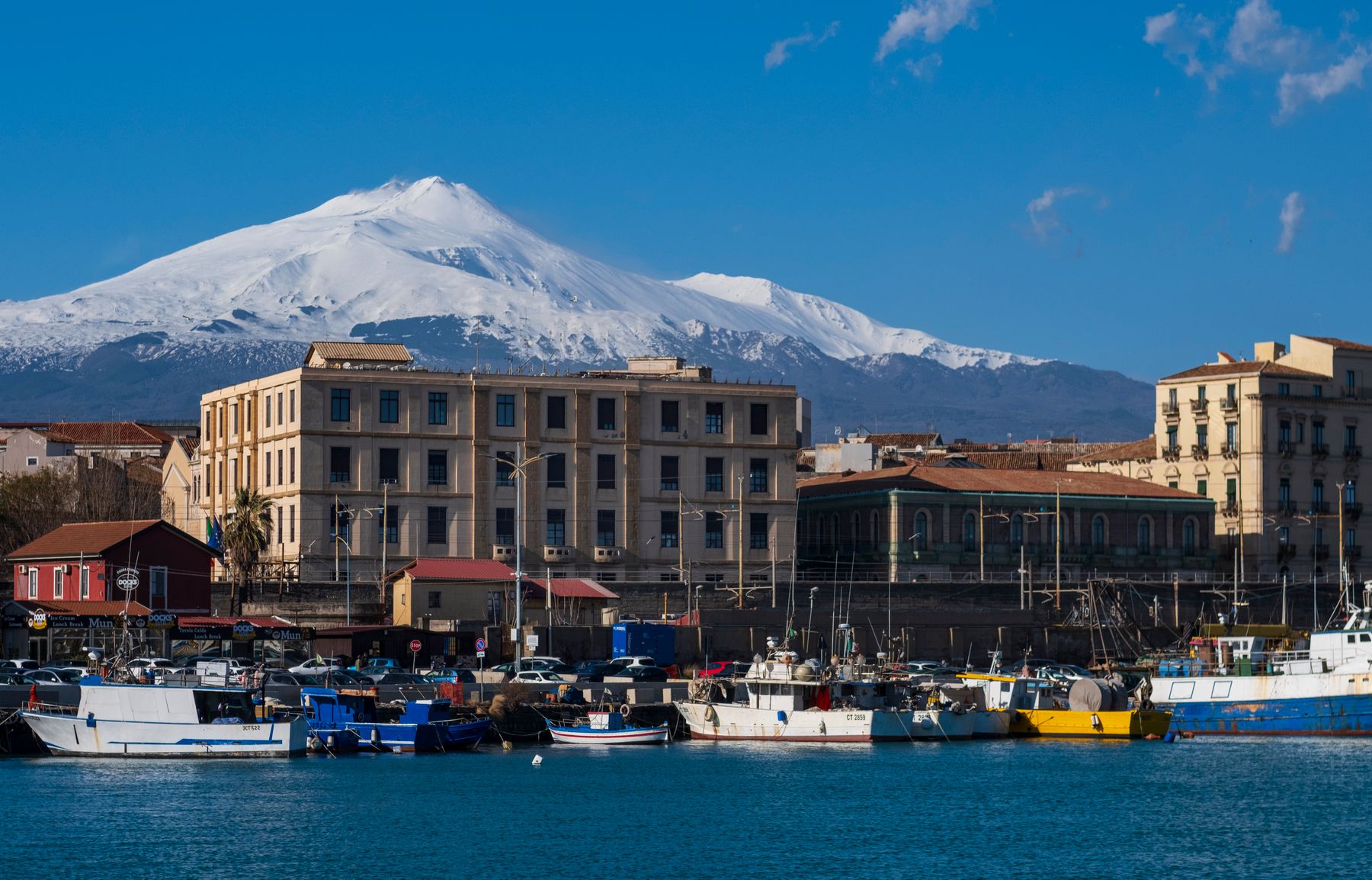
Fact-checked 22 July 2026.
Catania is not Taormina without the view
Catania is frequently treated as an interchange: airport, rental desk, motorway, then onward to a prettier coastal town. That is a poor reading of Sicily's second-largest city. Catania is a port, university and market city shaped by Etna, earthquakes, commerce and a large population that uses the centre for purposes beyond holidays. Its principal sights sit close enough for a day on foot, but the experience requires accepting noise, worn façades, traffic and the contrast between restored monuments and streets still waiting for investment.
The city works as a series of layers. Piazza del Duomo displays the planned eighteenth-century reconstruction. The Roman theatre occupies the middle of a dense residential block. Castello Ursino is a medieval fortress that once stood much closer to the sea and now lies inland after lava altered the shoreline. In the markets, fishmongers, produce sellers and porters work inside the same core that visitors photograph. One day covers the main argument; two create room for museums, San Berillo, Villa Bellini and the Aci coast.
Katane, lava and reconstruction: the historical key
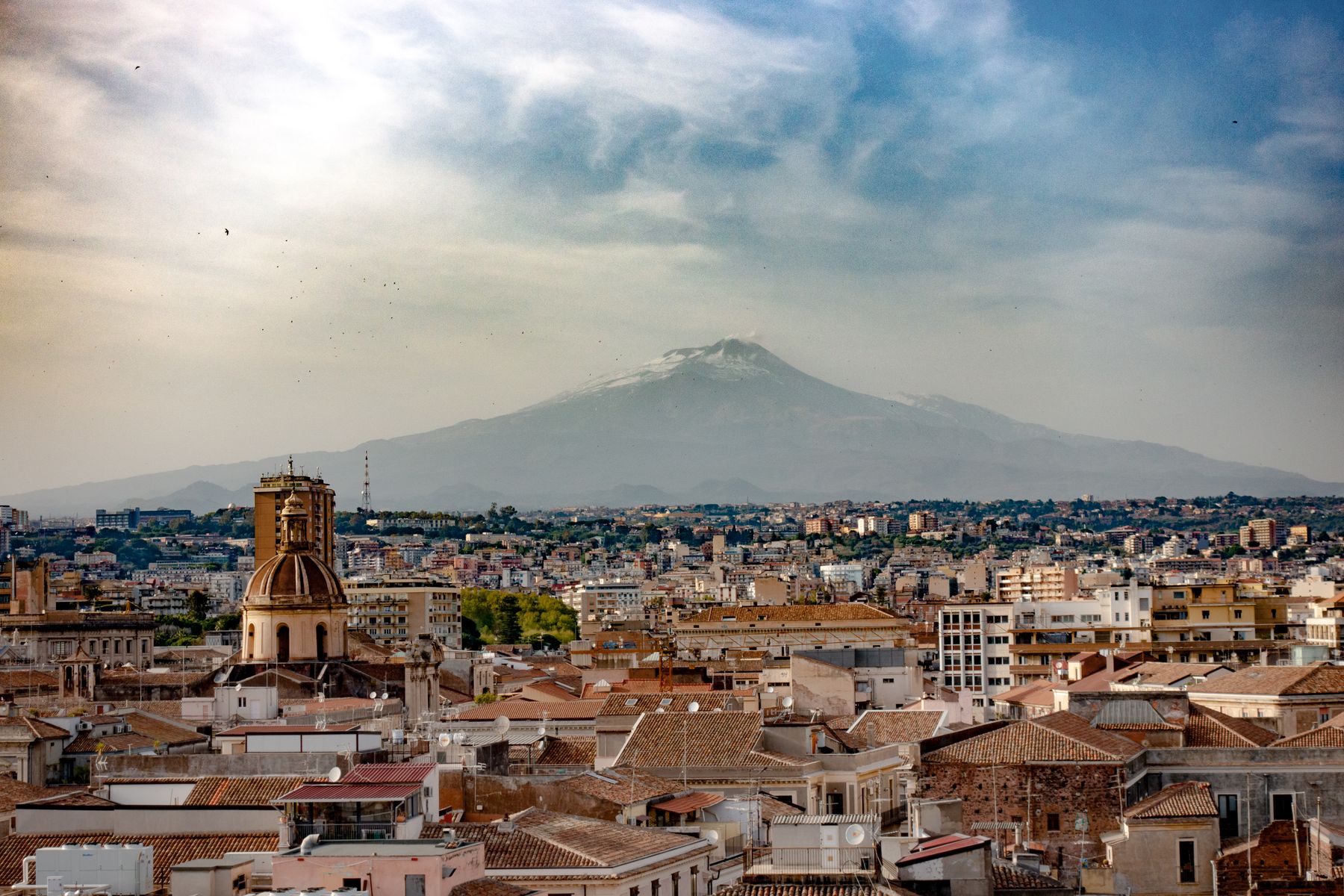
Ancient Katane was founded during Greek colonisation in the eighth century BCE in a territory where Sicel communities already had their own histories. The city changed hands during conflicts among Greek powers and later became Roman. Remains of a theatre, odeon, amphitheatre, baths and roads are dispersed through the centre because the modern city never withdrew from the ancient one. Catania is not an archaeological enclosure; it is a functioning city over its predecessors.
The clearest medieval power structure is Castello Ursino, built under Frederick II in the thirteenth century. The fortress was tied to Swabian royal authority and later served roles under Aragonese rule. It stands inland today, but before Etna's major 1669 eruption it was close to the shore. Lava surrounded parts of the area and pushed the coastline outward. The next great rupture came in 1693, when the Val di Noto earthquake destroyed much of Catania and towns across the south-east.
Reconstruction produced the broad axes and Baroque architecture now included in UNESCO's serial property, the Late Baroque Towns of the Val di Noto. Unlike Noto, Catania was rebuilt on its earlier site. Architects including Giovanni Battista Vaccarini worked with a local palette of dark lava and pale limestone. The result is more than decorative churches. It is post-disaster urban planning, with broader streets, representative squares and institutions of power assembled again.
A one-day route through Catania
Begin at Piazza del Duomo before heat and groups
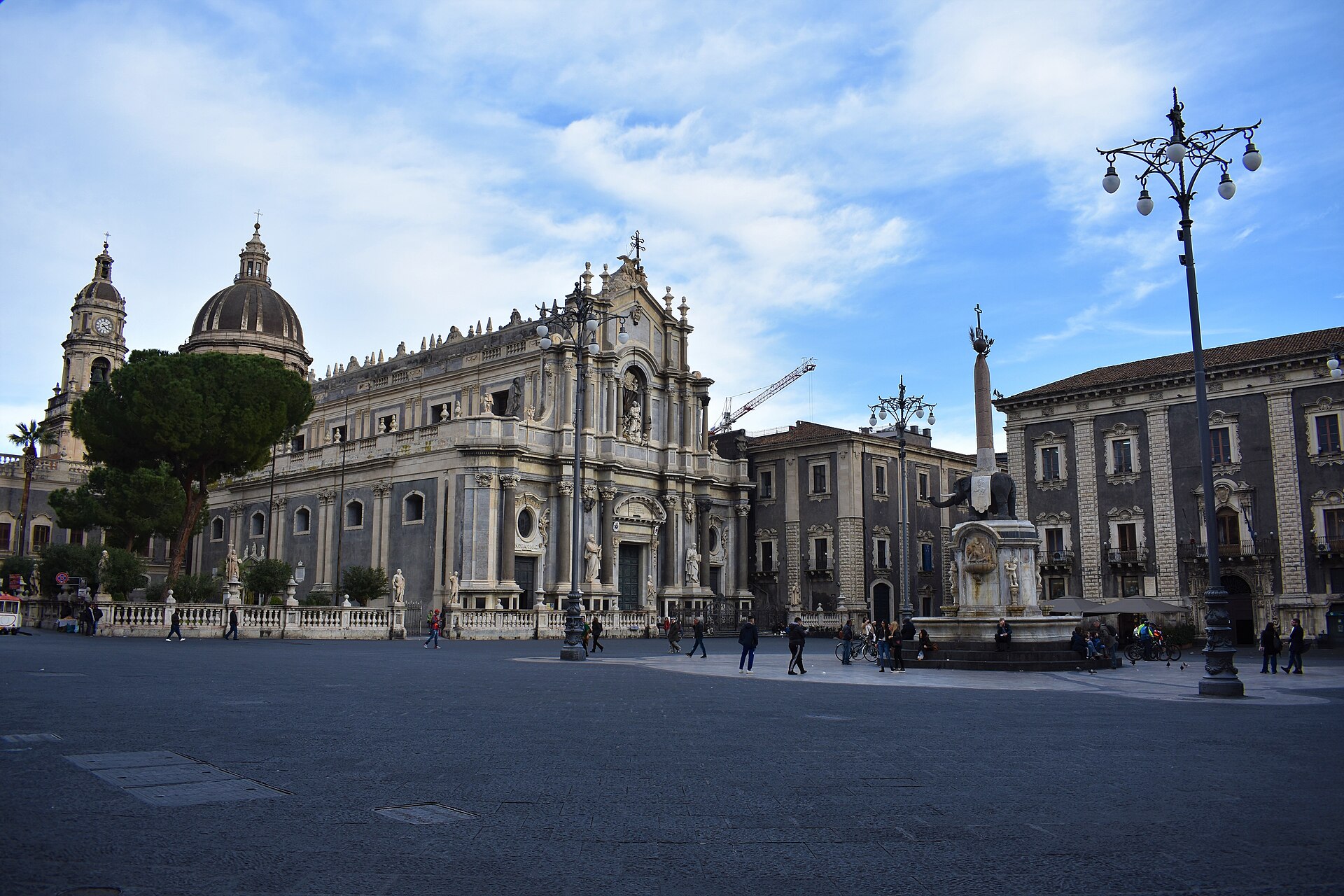
Start between eight and nine, while deliveries and commuters still outweigh day visitors. At the centre is the Elephant Fountain. Its black lava elephant carrying an obelisk, known locally as Liotru, is the city's emblem. Palazzo degli Elefanti, Palazzo dei Chierici and the Cathedral of Sant'Agata frame the square. The cathedral combines Norman origins, earthquake damage and Baroque rebuilding. Enter with covered shoulders and restraint, particularly during a service.
Sant'Agata is not merely a name on a façade. The major February festival mobilises religious devotion, family identity, craft, traffic and city administration on a scale that an ordinary museum day cannot communicate. Outside the festival, her symbols remain visible on buildings and votive objects. The Baroque core is still a religious landscape, not a collection of retired churches.
Descend into La Pescheria, treating it as work
Behind the Fontana dell'Amenano, steps drop into the fish market. La Pescheria is most active in the morning as fish, shellfish, meat, cheese and vegetables change hands. Exact activity varies by weekday, season and catch. Come for the sound, product knowledge and connection between port and kitchen, but buy something or move on rather than stopping narrow passages. Red canopies and shouted prices are visually compelling; they are also working conditions.
Bars and restaurants surround the market, though the most visible terrace is not automatically the strongest kitchen. A practical morning meal might be a cipollina, cartocciata or arancina; Catania generally uses the feminine form. If you choose raw fish or shellfish, use an established business with visible refrigeration rather than romanticising every counter.
Follow Via Etnea to Piazza Stesicoro
Via Etnea runs north from the cathedral as both shopping street and sightline towards the volcano when weather is clear. The palaces of Piazza Università express the representative reconstruction. Farther on, Piazza Stesicoro exposes part of the Roman amphitheatre below current street level. Only a portion is excavated and visible; the rest continues beneath the dense city. That limitation is instructive. Catania's antiquity is embedded rather than isolated.
Turn into Via Crociferi
A short detour from Via Etnea reaches Via Crociferi, a compact street with an unusual concentration of churches, monasteries and Baroque fronts. The Church of San Benedetto and its covered arch create the best-known perspective, but the institutional density is more interesting than a single image. After 1693, religious orders used reconstruction to restore practical facilities and social standing. Church opening hours vary, so do not design the day around every door being open.
See the Roman theatre from Via Vittorio Emanuele II
The Roman theatre stands a few streets away, its cavea and stage compressed among later buildings. Water can appear in the lower parts depending on conditions. The adjacent Odeon was a smaller performance structure. The visit needs at least three quarters of an hour and some attention to the site's changing uses. Check admission and opening with Sicily's official archaeological parks, because maintenance can alter access.
Give the Benedictine monastery proper time
Continue to Piazza Dante and the vast Benedictine complex. Founded in 1558, affected by the 1669 eruption and the 1693 earthquake, it was rebuilt from 1702. Beneath and around it survive traces of older Catania and lava, while cloisters, stairs, kitchens and formal rooms express the order's economic strength. Since 1977 the complex has belonged to the university. It is simultaneously heritage and workplace.
Guided visits run to a programme worth checking or reserving. A tour can explain the passage among Roman remains, lava, monastery and present faculty in ways the courtyard alone cannot. The municipality provides background through its official monument portal.
Finish at Castello Ursino and Piazza Federico II di Svevia
Walk down through the residential centre to Castello Ursino. The heavy geometric fortress contrasts with the movement of eighteenth-century façades. It now houses the civic museum, including archaeology, sculpture, painting and the historical Biscari and Benedictine collections. At the date of checking, the official museum site listed daily opening from 09:00 to 19:00, last entry at 18:00, and a full ticket of €6. Times and prices change; confirm on the official Castello Ursino website.
The streets around the castle work well for an early dinner, but choose by kitchen and atmosphere rather than a view of the walls. If energy remains, walk towards the port or return to Via Etnea and Villa Bellini. Do not also force Etna or Taormina into the day. They are separate excursions, mapped in our guide to 20 things to do in eastern Sicily.
An extra day: neighbourhoods beyond the main line
San Berillo between renewal and displacement
San Berillo, east of Via Etnea, was partly demolished during a major mid-twentieth-century clearance that displaced residents and left breaks in the urban fabric. Today it contains homes, nightlife, migrant businesses, art initiatives and sex work. Visitors should not turn the quarter into an “edgy” photographic set. Walk public streets, support a business and respect people who did not consent to become subjects.
Fera 'o Luni at Piazza Carlo Alberto
The market around Piazza Carlo Alberto is known as Fera 'o Luni even though trade is not limited to Monday. Clothing, household goods, produce, cheese and many other items fill the space. It offers a less compact visitor narrative than La Pescheria and a clearer view of everyday commerce. Watch belongings in dense passages and ask before close photographs of traders. The square changes markedly after stalls close.
Villa Bellini and upper Via Etnea
Villa Bellini offers shade, elevation and a pause from streets. Continuing north, Via Etnea becomes more local commercial axis than monumental route. The Borgo area and metro stations reveal a scale of Catania rarely associated with the Baroque core. That is useful for understanding the working city or using the metro, though not essential on a first tight day.
San Giovanni Li Cuti and lava at the sea
The small harbour and dark shore of San Giovanni Li Cuti are reachable by local transport, taxi or a long walk. This is an urban beach with fishing boats and volcanic material, not an isolated nature site. In summer residents often arrive late in the day as the sun falls. Entry to the water and space become difficult with waves and crowds; other shores are better for a conventional beach day. Compare them in our Catania and Taormina beach guide.
Eating in Catania without a mechanical checklist
Catania's food reflects port, volcanic hinterland and dense street economy. Pasta alla Norma brings together tomato, aubergine, ricotta salata and the city's relationship with composer Vincenzo Bellini. Horse meat is sold and grilled particularly in certain central streets and is a genuine local custom, not an obligation. Granita is commonly eaten at breakfast with brioche in warm weather; texture and flavours vary among bars. Kiosks serve seltzer with lemon and salt or fruit syrups, a city practice developed around cooling drinks in the heat.
Meal hours matter. Many restaurant kitchens do not open for dinner until 19:30 or later, while bars, bakeries and tavola calda fill the gaps. Families with early eaters should plan a substantial bridge snack. Look for a menu that fits place and season rather than an endless catalogue of every Sicilian standard. Reserve on Friday and Saturday, especially for small popular rooms.
Transport, parking and timing
| Situation | Practical choice | Trade-off |
|---|---|---|
| From the airport | ALIBUS to the centre | Traffic-dependent; validate the correct ticket |
| From Giarre/Riposto | Train to Catania Centrale or edge parking | Timetable or walk from parking |
| Inside the centre | Walk, with metro for longer sections | Uneven pavements and summer heat |
| To the Aci coast | Regional train, bus or car by destination | Stations are not always beside the shore |
On 22 July 2026, the official airport site stated that ALIBUS operated between the airport and Catania from 04:40 until 00:30, at about 25-minute intervals. AMTS listed a €4 fare with 90 minutes' validity on other AMTS urban routes. Operations change, so use the current AMTS ALIBUS page, not an old travel post.
Drivers should select legal parking outside the narrowest centre streets and walk. ZTL and pedestrian areas make improvised driving risky, and entering a hotel name in navigation is not a permit. Leave nothing visible in the car. From Casa Parisi, rail can be attractive for a pure Catania day; a car is more flexible for Etna or multiple rural stops. Our Catania Airport to Giarre guide compares arrival options.
July and August demand an early start, water and a midday plan. Markets belong in the morning in any case. Spring, autumn and winter suit long urban walks, though rain makes lava paving and smooth stone slippery. During the Sant'Agata festival, major concerts and public events, traffic, openings and crowds change substantially.
Catania's productive contradiction
The city's heritage is monumental, while its economic reality is uneven. The university brings youth and scholarship into historic structures. Tourism supports work around markets, accommodation and restaurants. At the same time, empty or poorly maintained buildings, waste problems and neighbourhoods exposed to displacement are visible. Catania becomes less intelligible if visitors either romanticise wear as “authenticity” or reject the city for lacking polish.
The right comparison is not Florence or Rome in miniature. Catania functions as a southern port beneath an active volcano, with a Baroque core produced after catastrophe and modern outskirts that most visitors never see. The tension between representation and daily logistics is what makes a day here more revealing than another panoramic promenade.
Official sources
History and monument information was checked against Visit Sicily, the Comune di Catania monument portal, UNESCO's Val di Noto record and Museo Civico Castello Ursino. Transport details were checked with Catania Airport and AMTS. Always confirm opening hours, tickets and service changes shortly before visiting.
Conclusion: give the city a complete day
Catania does not reward the traveller arriving between two flights in search of one perfect postcard. It rewards connections: the fish market after the cathedral square, a Roman theatre inside residential blocks, a university within the monastery and a fortress surrounded by land created by lava. Walk the route slowly, eat when the city eats and let Etna remain physically present without turning it into the background of every image. Catania then stops being an airport gateway and becomes the city that explains the principal forces of eastern Sicily.
If you have less time, choose the cathedral square, the market and one major historic site. That gives you a better visit than rushing past every sight. If you return another day, explore the outer neighbourhoods, Villa Bellini or the coast at San Giovanni Li Cuti.