Fact-checked 22 July 2026. Film locations and historical information were checked against the Municipality of Savoca and official Sicilian tourism sources. Opening and access must be confirmed locally.
Savoca is both a film location and a real hill town
Savoca became globally recognisable through Francis Ford Coppola's 1972 film The Godfather. Visitors come to sit at Bar Vitelli and walk to the church where Michael Corleone and Apollonia marry in the story. Those places exist, and the film connection is a legitimate part of the town's recent cultural history. Yet the town is not Corleone, and its centuries of religious, rural and civic life did not begin when a film crew arrived.
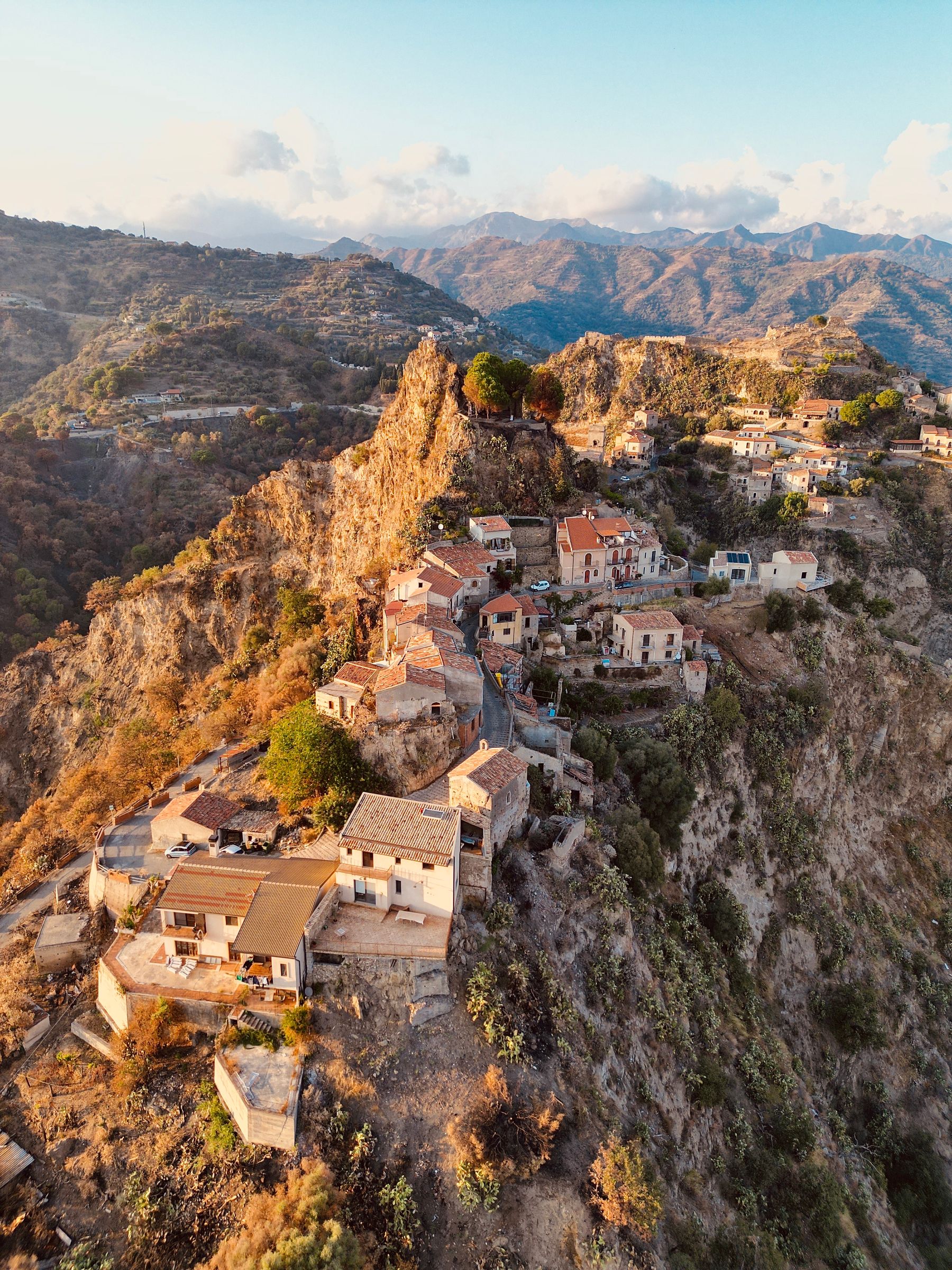
The most useful way to visit Savoca is to hold two stories at once. One is cinema's constructed Sicilian world, in which real buildings play places they are not. The other is Savoca's own history on a ridge above the Ionian coast: a fortified medieval settlement, a religious centre, a place with a Jewish population before 1492 and later a town that lost residents to the valley and coast. Film provides an entrance; landscape and records provide depth.
Savoca fits naturally into a half-day from Taormina, Giardini Naxos or the coast north of Etna. Our Taormina guide can place the visit within a wider trip. Do not plan the town as another quick photograph between numerous stops. Its steep lanes, views and churches require slow walking.
Why cinema's Corleone is far from Corleone
In the film, Michael Corleone travels to his family's Sicilian home territory. The real town of Corleone lies in western Sicily's interior south of Palermo. Savoca and neighbouring Forza d'Agrò, by contrast, are in Messina province on the eastern side. They appear as the fictional Corleone not because the geography matches, but because their historic streets and buildings could carry the film's visual idea.
This is not a pedantic distinction. It demonstrates how cinema makes place. When a camera connects a gateway, square and church, they become one fictional geography for an audience although the real route is different. Savoca was not merely “found”; it was interpreted, framed and reused as narrative. A responsible guide says “the place that played Corleone” and does not present the village as Corleone itself.
The film's international reach brought visitors and economic activity, but also a strong template for what outsiders expect from Sicily: honour, family, silence and organised crime. That image is a cinematic work, not neutral anthropology. Meet the contemporary village as an inhabited place where people work, maintain churches, run cafés and manage tourism, not as extras in a continuing Mafia story.
Bar Vitelli: a real building in a staged narrative
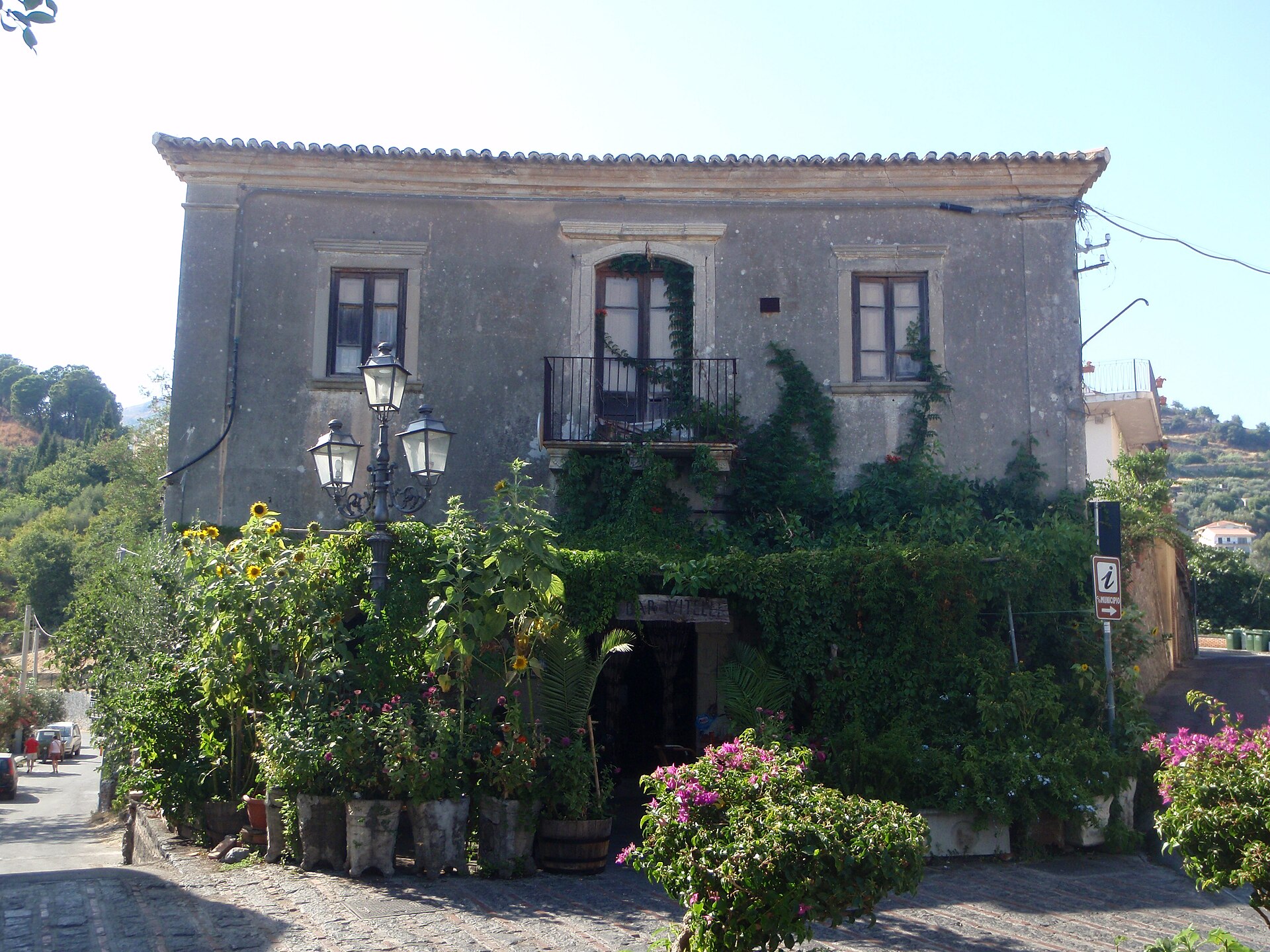
Bar Vitelli occupies the eighteenth-century Palazzo Trimarchi on Piazza Fossia. In the film, Michael meets the bar owner, asks about Apollonia and introduces himself under the gaze of local men. The façade, terrace and objects inside became the town's most photographed film traces. The name and continued use make the connection tangible, but a visit should not depend on the fantasy of stepping unchanged into the 1940s.
The palazzo and square exist in a modern visitor economy. Tables may be occupied, groups can arrive together, and prices or hours change. This guide does not endorse the café as objectively superior; it explains its role. When ordering, you buy both refreshment and an opportunity to sit in a place with film history. Also observe the square's relationship to the town gate and ridge, so the building does not become an isolated selfie.
The official regional Savoca film itinerary identifies Bar Vitelli and the church as principal locations. Use it as evidence for the connection, and ask the business directly about today's opening. Old travel blogs do not prove that a private establishment keeps identical hours or menu content in 2026.
San Nicolò: the screen wedding and the village church
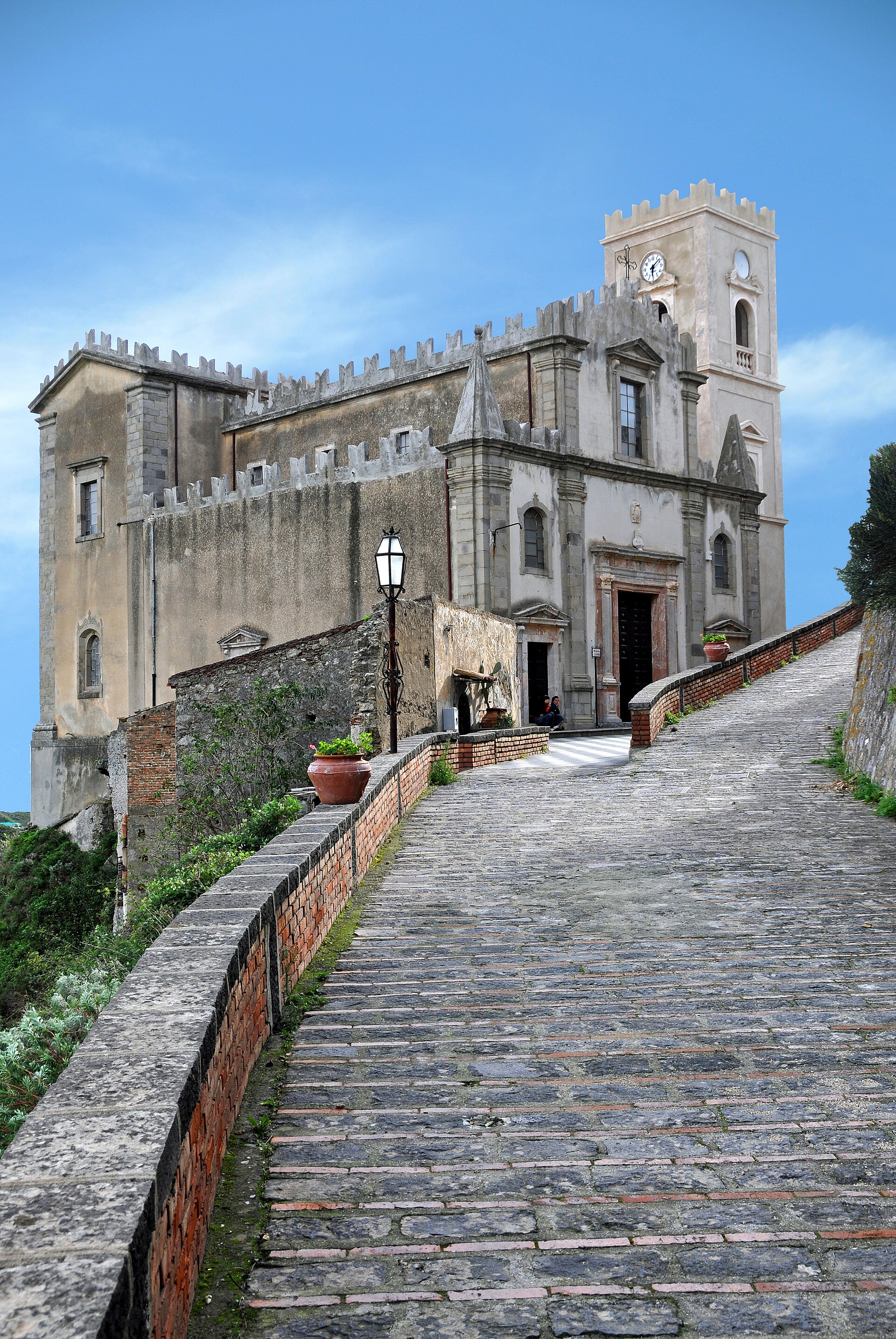
San Nicolò, also associated locally with Santa Lucia, stands dramatically on rock above the valley. Its exterior and steps form the setting for Michael and Apollonia's wedding and procession. The camera position makes architecture and landscape active participants. Walking from Piazza Fossia through town matters more than merely arriving at the door; it reconstructs the elevation that the film uses.
The church is also a religious space. Entry may depend on worship, maintenance and local staffing. Cover shoulders and knees, speak softly and allow a ceremony priority over a photograph. Film fans do not own the site symbolically because they recognise it. If the door is closed, the exterior and view remain meaningful; never pressure a private function for access.
Today's architecture carries changes and restoration, not a frozen medieval condition. That is typical of Savoca, where earthquakes, economics and population change affected buildings. Ask not only “where did the actor stand?” but why a church was placed so visibly on the ridge and how its congregation reached it.
Forza d'Agrò belongs to the film route but is not Savoca
Several scenes in the Godfather films were shot in Forza d'Agrò, another hill town north of Savoca. Excursions often bundle the two, which is logistically sensible but can erase their identities. Forza d'Agrò has its own urban form, churches and views. A combined visit should describe two municipalities, not one dispersed film set.
With a car and a full day, they can be linked with lunch and unhurried walks. On a half-day, Savoca alone is usually sufficient, especially in heat. Collecting every camera angle does not necessarily create understanding. Choose Savoca if Bar Vitelli, the wedding church and town history are central; add Forza d'Agrò if you also want to study how editing made a fictional geography out of several villages.
Savoca's history before Coppola
The Municipality of Savoca relates the town's development to the Norman period and traditions concerning Roger II around 1134. A 1139 donation to Messina's archimandrite institution appears in the documentary tradition. The Pentefur ridge may have older roots, but its origin is not fully certain. It is important to separate municipal historical sources from later legends that label every wall Phoenician, Byzantine or Norman without evidence.
The name is often explained through the elder plant, locally savucu, which grew in the area. Its position roughly 300 metres above sea level between the Savoca and Agrò watercourses offered defence, visibility and distance from coastal threats. It also imposed steep links to fields and trade. The landscape was not selected for a modern panorama but for the relationship between security, land and routes.
In medieval and early modern times, Savoca held importance as an administrative and religious centre for a wider territory. Churches, convents and fortification reflect not a metropolis but a concentration of institutions within a rural society. The municipality's historical account is the best official entry to this long development.
The Jewish presence and 1492
Savoca had a Jewish population that the municipal history estimates at about two hundred people before the expulsion of 1492. Sicily was then under the Spanish Crown, and the Alhambra Decree's expulsion policy struck Jewish communities across the island. A building in Savoca's historic fabric is associated with the synagogue, although later uses and survival make it less immediately legible than a functioning sanctuary.
This history should not become a curiosity between film locations. Two hundred people in a small town represent households, crafts, trade, worship and relationships that were broken. Absence is part of the landscape. Treat the site respectfully and do not invent details about ritual or named individuals where sources do not provide them.
The Jewish history also shows that “traditional Sicily” was never one homogeneous culture. Savoca was connected to wider Mediterranean and political systems long before tourism. That makes the town more complex than the cinematic image of a closed, unchanging community.
The gate, Pentefur and religious buildings
The old city gate marks entry to the historic centre and helps explain Savoca as a fortified place. Above it are ruins on the Pentefur ridge, traditionally associated with the castle's core. Ruins require caution: follow signs and barriers because surfaces and conservation can change. The view makes the relationship among ridge, valleys and Ionian coast intelligible.
The Mother Church of Santa Maria in Cielo Assunta was a central ecclesiastical site. San Michele, with origins in the thirteenth century and notable Sicilian Gothic portals, presents another architectural phase from the film church. Walking between them reveals the scale of religious infrastructure that a small town contained. Churches were not merely monuments; they organised calendars, burial, charity and social belonging.
Choose two or three buildings and read them carefully rather than chasing every door. Many churches have limited or volunteer-staffed opening, and a closed interior is not a failure of the destination. Façades, position and the line of streets still describe institutional roles.
The Capuchin convent and crypt demand respect
The Capuchin convent and crypt are known for preserved and mummified bodies of members of former local elites. The practice reflects burial customs, status and religious ideas of its time. These are human remains, not horror props or an extension of a gangster film. Visit quietly and follow the site's photography rules.
Explain in advance what children may encounter, and give everyone the option to wait outside. Do not take concealed photographs where photography is prohibited. Avoid jokes and posing. A museum or religious space holding dead people demands the dignity one would expect at a burial ground.
The crypt can illuminate how Savoca's institutions and families presented themselves, but it should not stand alone as a “strange sight”. Connect it to the mother church, population history and later decline so that the practice has context.
Decline, movement to the valley and the modern municipality
From the late eighteenth century, the high town gradually lost importance and population as activity moved towards the valley and newer coastal settlements. Transport, employment and modern construction favoured lower areas. The process appears across Sicily, where the defensive advantages of hill towns became practical disadvantages in an economy oriented to roads and coast.
Savoca's municipal autonomy was restored in 1948 after administrative changes. The film production just over two decades later gave it international visibility that local businesses have used ever since. Tourism can support cafés, maintenance and awareness of heritage, while an overly narrow film economy can turn every building into merchandise for the same narrative.
The modern challenge is to let screen history fund attention without erasing everything else. A visitor helps by buying locally, staying beyond the brief group stop and reading municipal interpretation. Entering a church or discussing the landscape does not reject The Godfather; it expands the reasons why the location remains.
Food and daily life without props
Local cooking draws on hill agriculture as well as links with the coast. Bread, cheese, olives, citrus, vegetables, meat and sweets may be relevant, but menus change and dishes rarely originate within a single municipality. Ask what is seasonal and local instead of treating a “Godfather menu” as a certificate of authenticity.
A meal allows you to remain after day groups depart. Choose by current menu, location and need, not a claim to be the town's objectively best restaurant. Booking is sensible on weekends and in high season, but current hours must come from the business itself.
Respecting daily life is simple: do not block a doorway for a photograph, move aside for deliveries and lower your voice in residential lanes. Drones require legality, safety and consideration; a beautiful ridge does not turn private roofs into unrestricted airspace.
Transport: how to reach Savoca in practice
Savoca is a hill town of steep paved streets. Car, taxi, private driver or organised excursion are the most practical options. Park in permitted areas near the centre and continue on foot. A vehicle cannot bring you to every film location, and the walk through town is precisely what connects the visit.
The nearest coastal corridor around Santa Teresa di Riva has rail and regional transport, but the final climb to Savoca is not a simple frequent railway connection. Buses and local solutions may depend on season and weekday. Check the particular date with an operator or pre-book a taxi, including the return. Do not assume an app will find a free vehicle in the hill town.
If driving, use our Sicily car-rental guide. Follow parking signs, do not enter restricted historic lanes, and favour a small car if the rest of the journey includes hill towns. The designated driver should not drink wine over lunch.
Time of day, heat and accessibility
Morning and late afternoon offer cooler walking and often quieter squares. In midsummer, the steep stone streets quickly become tiring in the midday heat, while winter and shoulder seasons can bring wind and rain. Wear shoes with grip and carry water and sun protection. Savoca is small on a map, but elevation makes a two-hour visit physically larger than its distance suggests.
Historic paving, steps and gradients limit step-free access. Travellers with reduced mobility should contact the municipality, attraction or guide about a specific route and the nearest lawful drop-off. A panoramic visit around Piazza Fossia and accessible viewpoints can still be meaningful if San Nicolò or Pentefur cannot be reached.
A half-day is appropriate for the film sites, two churches, views and a pause. A full day leaves space for Forza d'Agrò or a slow lunch, but do not automatically combine it with Etna and Taormina. Mountain roads and parking turn three “small” destinations into a long transport day.
A route connecting cinema and history
Begin at Piazza Fossia and Palazzo Trimarchi. See Bar Vitelli as both a location and part of the square's architecture. Pass through the old gate and continue up the main route. Turn towards San Nicolò for the wedding perspective, but give time to the church's own position and the valley view.
Continue, according to energy and opening, towards San Michele, the mother church or Pentefur. Choose the Capuchin crypt only if the group wants that cultural history and can encounter it respectfully. Return through the lanes rather than following exactly the same photographic route; side views reveal homes, gardens and terraces that a film map misses.
Finish with food or coffee, and consult the official Visit Sicily guide to Savoca and the municipal history. Paramount's official page confirms the film and its release; local history should come from local sources.
Savoca is most interesting when the set gains depth
You can certainly arrive as a Godfather fan. Recognition at Bar Vitelli and San Nicolò is real, and the landscape shows why the crew selected it. The best respect for the film, however, is to understand its craft: Savoca plays another town, multiple locations are edited into one world, and the narrative highlights particular ideas of Sicily.
Once you also see the gate, varied churches, the absence left by the Jewish community, population movement and present daily life, Savoca ceases to be a set. It becomes a place that has survived changing powers, economies and narratives, including the narrative that now brings you there.